There is a very specific kind of betrayal that happens only when you travel by air. You have spent real time and real money in the terminal selecting your snacks with care. Not the sad newsstand pretzels. The good stuff — maybe the $9 mixed nuts from that one kiosk, the dark chocolate you hid under your boarding pass, the dried mango that took three different stores to locate because it has to be that brand. You have constructed a carry-on snack situation that is, frankly, a work of art.
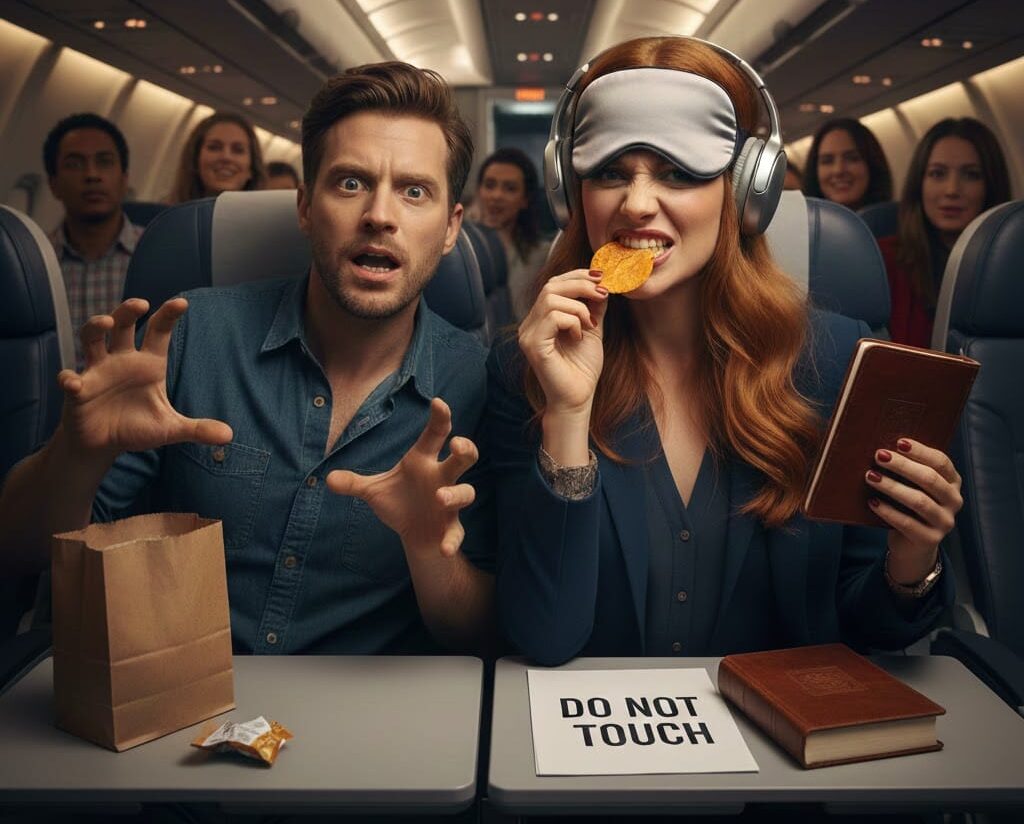
Then you open the bag, and Brad turns his head. Slowly. With that look.
He has had twenty years to learn that look. It says: I would also like some of that. He did not pack snacks. He never packs snacks. Instead, he walks through the terminal eating an airport burrito the size of a small animal and then, at altitude, decides he is interested in my carefully curated dried mango.
I am a nurse. I understand resource allocation. And I am here to tell you that the snack conversation on family trips is one of the most quietly intense negotiations that happens in any relationship.
The Travel Packing Problem
The snack disparity in most travel partnerships comes down to who planned and who showed up. In our family, I am the planner. I research what is available at the airport, I bring things from home that I know the girls will actually eat, I think about blood sugar at hour four of a flight because I have watched enough patients crash after skipping meals to take low blood sugar seriously.
Brad shows up. He is wonderful and I love him and he shows up with nothing but his AirPods and an entirely reasonable expectation that I have handled this.
So we have established a rule, and I recommend it to every traveling couple: before boarding, you declare what is communal and what is personal. “I got this trail mix for us” means everyone can have it. “I got this single chocolate bar and I am not sharing it and I will be very sad if you ask” is a complete and legally binding sentence. Silence means the default is solo consumption. This is not negotiable.
The 30-Second Travel Window
There is a brief moment after you open a bag — maybe thirty seconds — when it is still socially acceptable for your travel partner to give you the look. If you make eye contact during this window, you have opened negotiations. One piece, offered voluntarily, closes the matter. If you successfully avoid eye contact, the window closes. Any subsequent attempts are Passive Aggressive Scavenging, which in our house has a name and a face and that face is Brad’s.
PAS comes in several forms. The theatrical sigh. The slow lean toward your snack hand. The completely unprompted announcement that the in-flight menu “looks terrible, it really does.” I have seen all of these. I have become immune to none of them, which is why Brad usually gets some of the dried mango.
Traveling With Kids Changes Everything
Adult snack politics are complicated. Child snack politics are a different sport entirely. When we fly with our daughters, the snack bag becomes communal property immediately upon takeoff regardless of any prior declarations, because the alternative is a very long flight.
What I have learned after years of family travel: the snacks that matter most are the ones at hours two through four. Everyone does fine at boarding — there is novelty, there is excitement, there are screens. The turbulence (literal and figurative) starts at hour two when the novelty has worn off and someone is bored and someone else is hungry and someone is asking if we are almost there and the answer is “no, not even close.”
This is when you need the reserves. The thing you held back. The secret granola bar in the bottom of your bag that you did not announce at boarding. Think of it like emergency medication — you do not use it until you need it, and you always keep some back.
What Actually Travels Well
After enough family flights to feel like a recurring character in an airport, here is my honest list:
- Dried mango and dried apricots — no mess, sustained energy, kids actually like them
- Individual packs of nut butter — pairs with anything, high protein, keeps everyone stable
- Dark chocolate in a small amount — this is the reward item, deployed strategically
- Cheese crackers in a hard container — because a bag of crackers crushed in a carry-on is a tragedy
- Something savory and salty — people always forget that sweet-only snack packs leave everyone feeling worse after hour two
What does not travel well: anything that needs refrigeration and you convinced yourself would be “fine,” anything in a bag that will explode when the cabin pressure changes (ask me about the hummus incident of 2023), anything that smells strongly enough that the person in the row behind you turns around.
The Part About Letting Go
Here is the honest truth about travel snacks: by hour three, the ownership boundaries dissolve anyway. Everyone is tired. The kids have migrated into Brad’s seat somehow. Someone has spilled something. The dark chocolate comes out and gets broken into pieces and passed around, and it is the best thing anyone has eaten all day, and it matters less who bought it than that everyone gets some.
Pack the good snacks. Declare your intentions at boarding. Maintain the 30-second window rule. And then, eventually, share the chocolate. That is the whole guide.