Los Angeles is one of the most exciting food cities in the world, and one of the easiest places to quietly overspend. Over the years Brad and I have built a whole system for eating well here without the financial hangover: rewards stacking, a few house rules, and one app that does most of the heavy lifting. I have now used inKind at 21 restaurants across Los Angeles, and this is our full playbook: a real receipt, the restaurants I would send a friend to, the ones I would skip, and the fine print that changed this year.
First, the night that started it. I once spent $340 at a restaurant I had been to a dozen times. Same menu, same table by the window, same server who knows I want extra bread. But a bottle of wine I didn’t technically need and a cheese board that was “just for the table” turned a Tuesday into a financial crime scene. I am a nurse. I budget obsessively, I meal prep on Sundays, and I have a spreadsheet for our family vacation fund. And yet Los Angeles has a very specific power to make me forget all of that the moment a sommelier says, “We just got in something really special from Burgundy.”
That is when I found inKind, and it changed how our family eats out.
Is inKind Worth It? Our Quick Verdict
Yes, at restaurants you would go to anyway. On a real family dinner at Shoreside in Santa Monica, inKind took $85.08 off a $273.18 night out, about 31%, between a promo at the table and cash back afterward. We have used it at 21 Los Angeles restaurants and never had a single problem paying. Where it is not worth it: chasing a deal at a restaurant you would not otherwise choose. A discount does not fix a meal you did not enjoy.
What inKind Is and How the Savings Work
inKind is a free app that partners with a specific set of restaurants. You pay your bill through the app instead of handing over a card, and in return you get some combination of three things: cash back in inKind credit after you pay, promos like $50 off a $150 bill, and bonus credit when you prepay a restaurant’s house account. inKind gives restaurants interest-free capital up front in exchange for that credit, which is how it can pass some of the savings on to you.
The exact numbers change often. When we last checked, the cash back for paying through the app ranged from about 5% to 25% depending on the restaurant, and on our Shoreside dinner it was 20%. Always check the current rate and any running promo on the restaurant’s page in the app before you go.
I was skeptical at first. In nursing we call this kind of thing “too good to be true” and then read the fine print very carefully. But after 21 restaurants, it has worked exactly as advertised every time.
A Real inKind Bill: Our Father’s Day Dinner at Shoreside
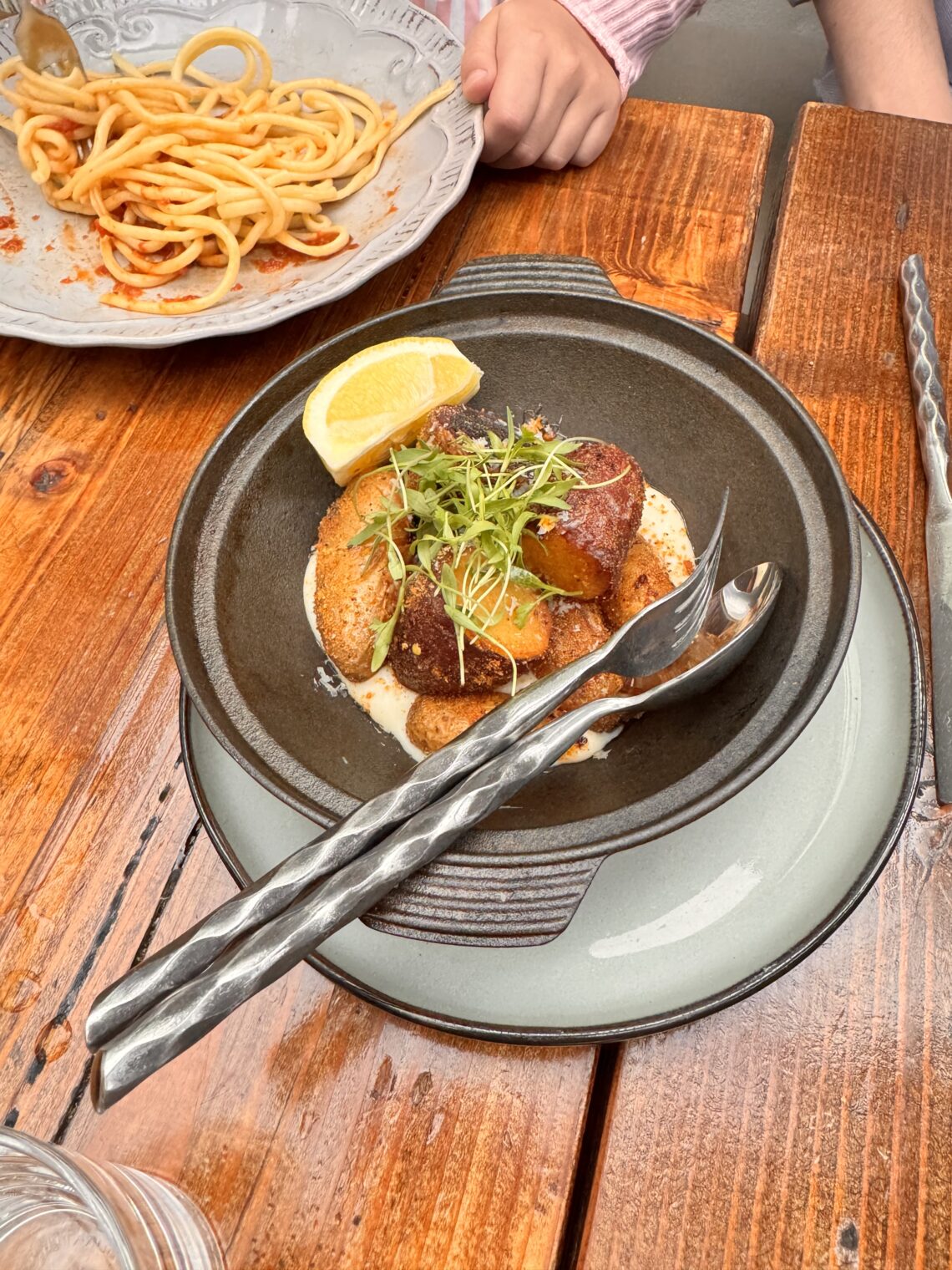
Here is one actual receipt, start to finish, from our family dinner at Shoreside Restaurant and Bar in Santa Monica. inKind was running a Father’s Day Treat promo: $50 off a bill of $150 or more.
| What we ordered | Price |
|---|---|
| Yellowtail crudo | $27.00 |
| Hummus | $21.00 |
| Ribeye | $90.00 |
| Kids’ spaghetti and meatballs (x2) | $36.00 |
| Shirley Temples (x2) | $14.00 |
| Chocolate opera cake | $12.00 |
| Subtotal | $200.00 |
| Tax | $25.38 |
| Bill | $225.38 |
| How inKind changed it | Amount |
|---|---|
| Father’s Day Treat promo ($50 off $150) | −$50.00 |
| Charged through inKind | $175.38 |
| Tip (on the full pre-promo bill) | $47.80 |
| Paid at the table | $223.18 |
| inKind Cash earned back (20% of $175.38) | −$35.08 |
| What dinner really cost us | $188.10 |
| Same dinner without inKind | $273.18 |
| Total saved | $85.08 (about 31%) |
Two things to notice. First, the promo came off the bill, but I still tipped on the full $225.38, because our server did the same amount of work either way. Second, the $35.08 in cash back went into my inKind Cash Back balance for a future dinner, so the real savings only count if you go back to an inKind restaurant within the cash back window. We always do.
How It Works at the Table, Step by Step
- Check that the restaurant is an inKind partner and look for a running promo on its page in the app. If you use a house account, load it ahead of time, because the bonus is applied when you load, not when you pay.
- Book your table the usual way through OpenTable, Resy, or the restaurant. inKind covers the bill, not the reservation.
- Eat your meal exactly as you normally would. There is nothing to tell the server.
- When you are ready, open the app, pick the restaurant, and enter your table or check number.
- The app pulls your bill, applies your promo or balance, and charges the rest and the tip to the card saved in the app. Cash back lands in your account afterward.
That’s it. No card dance at the end of the meal. The tip is the one detail people get wrong, so I want to be clear: the tip is charged separately, and I always tip on the full pre-discount total.
The Big Rule: You Can Only Use One Discount Per Visit
This is the part most inKind guides have not caught up on. For each visit, you choose one of these:
- Your inKind Cash balance (money you loaded, including Costco gift cards)
- Your inKind Cash Back balance (what you earned from past meals)
- A promo (like the $50 off $150 we used at Shoreside)
You used to be able to combine them. Not anymore. That matters most with the Costco inKind gift card, which loads $100 of inKind Cash into your account. It sounds like a great deal, but when you pay a meal with that $100, you do not earn cash back on it, and you cannot pair it with a promo that night. My strategy now: save loaded inKind Cash for a regular dinner with no promo running, and pay with a card whenever there is a promo, so I get the promo and the cash back.
The Fine Print Worth Knowing
- Expiration: the money you personally load never expires, just like a gift card. Bonus or promotional credit is valid for three years from purchase, and your paid balance is used first. Cash back you earn from dining expires much sooner, 60 days when we last checked, so use it.
- No refunds: inKind purchases are final. Load what you will realistically use in the next few months.
- Restaurants come and go: three restaurants we used inKind at, Massilia, Blue Plate Oysterette, and The Draycott, have since closed, and the Penthouse at the Huntley Hotel has left the app. If a restaurant closes or leaves the program, the balance you loaded there is the risk. Another reason not to overload.
- Takeout: it depends on the restaurant. Most of my go-tos treat inKind as dine-in only, but a few accept it for takeout ordered directly with them. Check the restaurant’s page in the app.
- Happy hour: usually stacks fine, because the savings are on the payment side, not the menu side.
- Sign-up offers: there is almost always a new-user promotion. I got an extra $20 on my first load.
How We Actually Use It
Brad and I have a rule now: before we book anywhere in Los Angeles that costs more than $80 a person, we check inKind first. If the restaurant is on the app, we look for a promo, then pay through the app with our American Express so we also earn Marriott Bonvoy points, which we put toward travel. Promo, cash back, and points on the same dinner. Suddenly the $25 crudo doesn’t sting the way it used to.
Our daughters have noticed. Our 10-year-old asked me recently why we go to “fancy restaurants so much.” I told her Mommy found a cheat code. She accepted this.
House Account or inKind Pass?
If you go to the same restaurant regularly, buy credit on that restaurant’s house account. In my experience the bonuses there tend to run higher, likely because the restaurant is courting your loyalty specifically, though that is not guaranteed.
If you are always chasing whatever just opened, look at the inKind Pass, which works across the network. inKind has changed how the Pass works more than once. When we last checked, it was an annual subscription that came with a monthly discount you could use at any partner restaurant, so read the current terms in the app before you buy it.
The Best inKind Restaurants in Los Angeles (We Have Tried 21)
This is every Los Angeles restaurant where we have paid with inKind, sorted by whether I would send a friend there. The partner list changes, so confirm each one is still on the app before you go.
Worth It: Where I Would Send a Friend
| Restaurant | Our full review |
|---|---|
| Teleferic Barcelona | Read our review |
| Sora | Read our review |
| Chelsea | Read our review |
| Sushi Roku | Read our review |
| Pacific Catch | Read our review |
| Fia | Read our review |
| Elephante | — |
| Kazan | Read our review |
| Katsuya Brentwood | Read our review |
| Pizzana | Read our review |
| Mother Wolf | — |
If I had to pick two: Pizzana, for the best neo-Neapolitan crust in the city (light and crisp, and it doesn’t weigh you down), and Katsuya Brentwood, my sushi home base for consistent, high-end food with efficient service.
Skip: Not Worth It Even With the Discount
I would skip Zaytinya, Red O, and Edgemar Restaurant + Lounge. Nothing went wrong with inKind at any of them. I just was not impressed with the food. We live in Los Angeles, with so many options for great food, and these places did not make the cut. A 20% discount on a meal you would not order again is not savings.
Also Used inKind Here
Shoreside Restaurant and Bar (our receipt above), El Torito, and Ospi Brentwood.
No Longer Available on inKind
The Penthouse at the Huntley Hotel has left the app, and Massilia, Blue Plate Oysterette, and The Draycott have closed. If you search for them in the app, that is why they are gone.
inKind FAQ
What is the inKind app?
inKind is a free restaurant payment app. You pay your bill through it at partner restaurants and get cash back, promos, or bonus credit in return. Restaurants use it to raise money up front, which is how the discounts are funded.
Is inKind legit?
In our experience, yes. We have used it at 21 Los Angeles restaurants and have never had a payment fail, a confused server, or a missing credit.
How much can you really save with inKind?
On our Shoreside dinner we saved $85.08 on a $273.18 night including tip, about 31%. That was a promo night. On a regular night with cash back alone, expect roughly the cash back rate shown for that restaurant, about 5% to 25% when we last checked.
Can you combine inKind Cash, cash back, and promos?
Not anymore. You pick one per visit: your loaded inKind Cash, your earned cash back, or a promo. Meals paid with loaded inKind Cash, including the $100 Costco gift card, do not earn cash back.
Is the Costco inKind gift card worth it?
It loads $100 of inKind Cash, which is handy, but you give up cash back and promos on the meals you pay with it. We use it on nights when no promo is running.
Do you tip on the discounted amount or the full bill?
The tip is charged separately to the card in the app. I tip on the full pre-discount bill, since the server’s work is the same.
Can I earn credit card points with inKind?
Yes. When you pay through the app with a card, the charge still earns your card’s rewards. We pay with our American Express and earn Marriott Bonvoy points on top of the inKind cash back.