
Brad turned forty-five last year and we did not do a small, tasteful dinner. We rented a house in Palm Springs for the weekend, invited fourteen people, and planned three days of food, pool time, and mild chaos. This is because Brad is the kind of person who, when asked what he wants for his birthday, says “everyone together,” and after twenty years I have learned to take that literally.
What I know about milestone birthday planning comes from this trip and from my own fortieth two years earlier, which was a dinner at a restaurant that required a reservation placed four months in advance. Both approaches worked. Here is what I have learned from each.
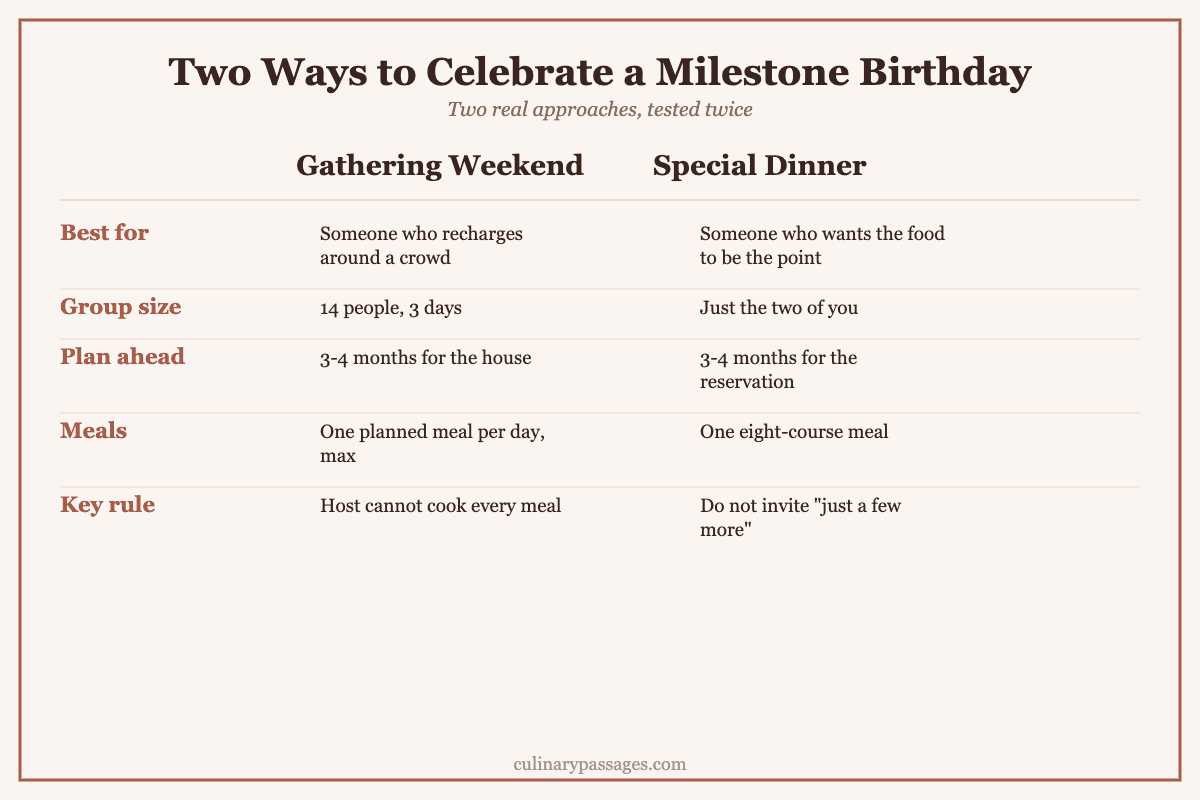
First, Match the Celebration to the Person
Before you choose a venue or send a single invitation, answer one question: does the person being celebrated recharge around a crowd, or around a small, focused experience? This is the whole decision, and getting it wrong is how well-meaning milestone birthday parties go flat. Brad lights up in a full house; I would rather have one extraordinary meal with the person I love than manage fourteen houseguests. Neither is more correct — they are just different people.
So ask, and listen to the real answer rather than the polite one. “I don’t want any fuss” sometimes means it, and sometimes means “I want to feel celebrated without having to organize it myself.” A quiet conversation weeks ahead — or a word with the person’s closest friend — tells you which birthday you are actually planning, and everything else flows from there.
The Gathering Approach
The Palm Springs house weekend worked as a birthday celebration because it was structured loosely and everyone was responsible for something. I cooked the Friday night dinner — a large batch of short ribs that I made the Thursday before and transported, plus salads and bread. Saturday was a catered lunch from a local taqueria delivered to the house. Saturday night we went to a restaurant as a group. Sunday was a big brunch that everyone contributed to. Nobody was overwhelmed and nobody sat idle.
The key for any multi-day gathering: one planned meal per day maximum. Everything else is grazing, takeout, or contribution. The host cannot cook every meal and also enjoy the weekend.
A few logistics make or break a group-house weekend. Confirm the sleeping arrangements before anyone commits so there is no awkward scramble over who gets the good room, and be clear up front about how costs are split — whether the house is your gift or a shared expense, say so in the invitation. Assign each household a loose role (Saturday coffee run, Sunday eggs, the ice and drinks) so the labor spreads out naturally. The whole point of the gathering approach is togetherness, and togetherness survives only if the host is not quietly doing everything.
The Special Dinner Approach
My fortieth was a counter-seat omakase dinner for two — Brad and I, an eight-course meal, no children. This is the right milestone birthday dinner if the person being celebrated wants the food to be the point. Make the reservation months ahead. Do not compromise on the restaurant choice because the wait was too long — that is what the milestone birthday is for.
If you are booking the dream restaurant, a couple of small touches make it feel more special without adding stress. When you make the reservation, mention it is a milestone birthday — many kitchens will do something quietly special, and you would rather they know in advance than scramble. Sort out childcare ahead of time so the evening has no logistical tail (for other kid-free date-night ideas, we keep a running list), and resist the urge to invite “just a few more people.” The intimacy is the entire point of this version; the moment it becomes a party of eight, it becomes a different, and harder, event.
A Simple Milestone Birthday Timeline
- Three to four months out: Lock the date and, if it is a hard-to-book restaurant or a rental house, reserve it now.
- Two months out: Send invitations with the real details — location, cost expectations, and what to bring.
- One month out: Confirm the headcount, arrange childcare, and plan the one-meal-per-day framework for a weekend.
- Two weeks out: Order or delegate food, confirm any private-dining or catering details.
- The week of: Cook and prep whatever travels, pack, and let the honoree do nothing.
What Does Not Work for a Milestone Birthday
A surprise party for anyone who has not explicitly requested a surprise party. The logistics of a surprise party are significant, and the person being surprised spends the first thirty minutes of their own party recovering from the surprise rather than enjoying it. Skip this unless you have strong evidence the person wants it.
A restaurant dinner for more than ten people that has not been organized as a private dining room or a prix-fixe menu. Large group dinners at regular tables produce two-hour waits for food, separate check crises, and people at the far end of the table who have a separate and inferior experience from people near the honoree. If the group is larger than eight, call the restaurant and ask about private dining options before you book.
And overloading the schedule. The instinct with a milestone is to cram in every good idea — the dinner and the activity and the toast and the slideshow and the late-night bar. Pick the two or three that matter and let the rest go. A birthday that feels like an itinerary you have to keep up with is not a gift; it is a job you have handed the guest of honor.
Frequently Asked Questions
How far ahead should I plan a milestone birthday?
For a big gathering or a coveted restaurant, three to four months is not too early — the best rental houses and the hardest reservations go fast. A simpler dinner needs only a few weeks, but the date itself is worth locking early so guests can hold it.
Who should pay for a group weekend?
Whatever you decide, say it plainly in the invitation. Some hosts gift the house and ask guests to cover their own meals; others split everything evenly. The only wrong move is leaving it ambiguous, which creates awkwardness at exactly the wrong moment.
Is a surprise party ever a good idea?
Only if you have real evidence the person genuinely wants one. Plenty of people love it; plenty spend the first half-hour recovering from the shock. When in doubt, celebrate openly — anticipation is part of the fun for most people.
Milestone birthdays are worth the effort precisely because they do not come around often. Whether you rent the house or book the counter seats, start from the person, keep the logistics honest and simple, and protect the guest of honor from doing any of the work. That is the whole point: they get to simply arrive, and be celebrated.