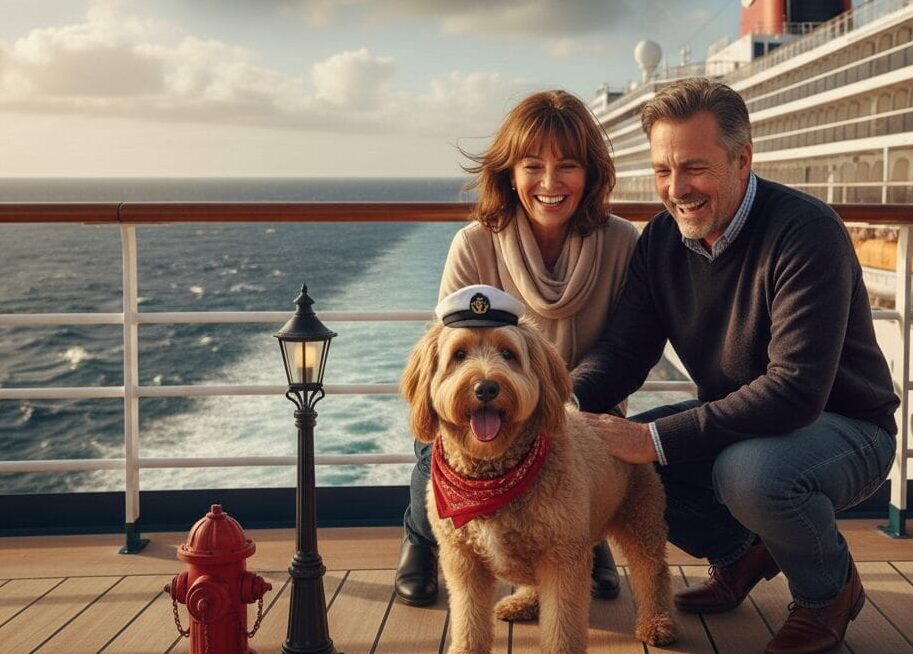
Let’s be honest. If you’re a dog owner, you’ve experienced “The Look.” It’s that heart-wrenching, soul-crushing stare your furry best friend gives you as you stand in the doorway, suitcase in hand. Their eyes, wide with betrayal, seem to say, “You’re leaving me for that giant floating buffet? Again?”
After years of guilt-ridden goodbyes before our family trips, from our quick Carnival cruise to Cabo to weekend getaways at luxe Orange County resorts, I finally cracked. I turned to my husband and declared, “Next time, Barnaby comes with us.”
He laughed. The kids cheered. I went down a rabbit hole of research so deep, I think I saw a ship captained by Alice in Wonderland. The result? An epic, slightly chaotic, and surprisingly successful week-long cruise across the Atlantic with our 25-pound terrier mix.
So, you want to take your dog on a cruise? Grab a leash, a very large coffee, and let me be your guide. Here’s everything I learned about turning your pup into a seasoned sea dog.
The Brutal Truth: Can You Actually Take Your Dog on a Cruise?
Before you start shopping for tiny sailor outfits, let’s manage expectations. Taking a pet dog on a major cruise line for a vacation is not just rare; it’s nearly impossible. Most cruise lines adhere to a strict “service animals only” policy.
According to the Americans with Disabilities Act (ADA), a service animal is a dog that is individually trained to do work or perform tasks for a person with a disability. It’s crucial to understand that this does not include emotional support animals, therapy animals, or companion animals. Trying to pass off a pet as a service animal is not only unethical but can also lead to you and your pup being disembarked at the next port of call.
So, where does that leave us devoted dog parents? With one glorious, majestic, and very British exception: Cunard’s Queen Mary 2.
For decades, Cunard has been the gold standard for transatlantic pet travel. Their “Pets on Deck” program is the only one of its kind, offering dedicated kennels and pet services on their iconic Queen Mary 2 ship, which regularly sails between New York and Southampton, UK. This isn’t a “stow your dog in the cabin” situation; it’s a structured, dedicated program designed for the safety and comfort of the animals.
Operation Sea Dog: The Ultimate Pre-Cruise Checklist
Getting Barnaby on that ship was a logistical feat that made planning our family dinner at Zaytinia look like child’s play. If you’re serious, here’s your battle plan.
1. Book Way, Way, Waaaaay in Advance
The Queen Mary 2 has a limited number of kennels (24, to be exact), and they sell out faster than tickets to a Taylor Swift concert. We booked our trip over a year in advance to secure a spot for Barnaby. When you call to book your own passage, you must simultaneously book your dog’s spot in the kennels. It cannot be added later.
2. Prepare for Paperwork Palooza
This is where your organizational skills will be tested. The requirements are strict and non-negotiable.
- Microchip: Your dog must be microchipped with a 15-digit ISO-compliant chip.
- Rabies Vaccination: Must be administered after the microchip is implanted.
- Tapeworm Treatment (UK Bound): If you’re traveling from New York to the UK, a veterinarian must administer a specific tapeworm treatment no less than 24 hours and no more than 120 hours (1-5 days) before arrival.
- Official Health Certificate: This is the big one. Depending on your destination, you’ll need an official health certificate endorsed by a government agency. For our trip to the UK, we needed an Animal Health Certificate (AHC) issued by a USDA-accredited veterinarian. The U.S. Department of Agriculture’s Animal and Plant Health Inspection Service (USDA APHIS) is your go-to resource for the exact forms and requirements for your specific destination. Plan for multiple vet visits.
Pro-Tip: Start a folder for all your dog’s documents the day you book the cruise. Trust me.
3. Pre-Boarding Prep for Your Pup
A cruise ship is a weird environment. There are strange noises, new smells, and lots of vibrations. We wanted to make sure Barnaby was as comfortable as possible.
- Crate Training: Even though Cunard provides a kennel, make sure your dog is comfortable being in a crate. This is their safe space.
- Socialization: The kennel area has a communal play deck. We practiced by taking Barnaby to some of our favorite (and busiest) pet-friendly patios in Santa Monica to get him used to being around other people and dogs in a controlled setting.
- Familiar Items: Pack a small, unwashed blanket or t-shirt that smells like home, along with their favorite non-squeaky toy. These familiar scents can be incredibly comforting.
The Price of Passage: A No-Holds-Barred Cost Breakdown
Taking your dog on a cruise is a luxury, and the price tag reflects that. It’s an investment in guilt-free travel! Here’s a general breakdown of what we spent for Barnaby:
| Item | Estimated Cost | Notes |
| Kennel Fee (Pet Ticket) | $800 – $1,000 | This is for one-way transatlantic crossing. Price depends on the size of your dog. |
| USDA Vet Visits & Health Certificates | $300 – $500 | Includes the exam, paperwork endorsement, and specific treatments like tapeworm. |
| Travel-Approved Crate | $70 – $150 | Even if you have one, make sure it meets airline/ship specifications if you’re flying to the port. |
| Pet Supplies | $50 | Special food, calming treats, a familiar blanket, etc. |
| Grand Total | **$1,220 – $1,700** | This is in addition to your own cruise fare. |
Life at Sea with Your Four-Legged First Mate
So what’s it actually like? Honestly, it was surreal and wonderful. A uniformed Kennel Master is on duty to walk, feed, and clean up after the dogs. Cunard provides fresh-baked dog biscuits, blankets, and toys.
Here’s a typical day:
- Visiting Hours: Pet owners have designated visiting hours throughout the day. We could go up to the kennel deck, take Barnaby out into the dedicated, wind-sheltered walking area (complete with a genuine American fire hydrant and British lamppost for decorative relief!), and play with him.
- Posh Pups: He wasn’t allowed in our stateroom or any of the public dining areas, but that was fine. The kennel area was his exclusive club, and he was living his best life. He made friends with a Pomeranian named Winston and a Golden Retriever named Daisy.
- Peace of Mind: The best part for us was the peace of mind. Instead of wondering how he was doing back home, we could go see for ourselves that he was safe, happy, and probably getting more pampered than we were.
The Verdict: Was It Worth It?
Absolutely, one hundred percent, yes.
But it’s not for everyone. Taking your dog on the Queen Mary 2 is a fantastic option for two types of travelers:
- People relocating between the US and the UK who want to avoid the stress and danger of putting their pet in cargo hold on a plane.
- True dog-lovers on a once-in-a-lifetime trip for whom the cost and logistics are a worthy price for the experience.
For a casual one-week Caribbean vacation? It’s just not an option. But for that specific transatlantic journey, it was an unforgettable experience that brought a whole new meaning to the term “family vacation.” Seeing Barnaby with his ears flapping in the Atlantic breeze is a memory I’ll cherish forever. No guilt, no sad goodbyes—just all paws on deck.
Frequently Asked Questions
Q: What cruise lines allow pet dogs? A: Currently, Cunard’s Queen Mary 2 is the only major, transatlantic cruise liner that allows non-service pet dogs. This is offered through their “Pets on Deck” program, which provides a dedicated onboard kennel facility and kennel master for transatlantic crossings (primarily between New York and Southampton). The reason this is so rare is due to complex international port regulations and strict public health rules, like those from the CDC’s Vessel Sanitation Program (VSP), which make it unfeasible for most ships to accommodate pets. Some small, local tourist boats (like river cruises in Chicago or Paris) or specialized European river cruises may also allow dogs, but for a major, week-long ocean voyage, Cunard is the only option.
Q: Can my dog stay in my cruise cabin with me? A: On Cunard, no. For health and safety reasons, all pets (dogs and cats) must reside in the kennel area on Deck 12. They are not permitted in staterooms or any public areas of the ship. The only exception to this rule on any cruise line is for qualified service animals. A service animal, as defined by the ADA, is a dog that is individually trained to do work or perform specific tasks for a person with a disability.
Q: What about Emotional Support Animals (ESAs)? Are they allowed in cabins? A: This is a critical distinction: No. Cruise lines, including Royal Caribbean, Carnival, and Norwegian, have policies that align with the airline industry—they do not recognize Emotional Support Animals (ESAs) as service animals. An ESA, which provides comfort, is not trained to perform a specific task for a disability. Therefore, they are considered pets and are not permitted to sail in passenger cabins. Your pet dog would only be allowed if traveling via Cunard’s kennel program.
Q: How much does it cost to take a dog on a cruise? A: On the Queen Mary 2, the cost is per kennel, per crossing (one-way). Prices vary by the size of the kennel required.
- Upper Kennel (for small dogs, ~25 lbs or less): $800
- Lower Kennel (for larger dogs, ~26 lbs or more): $1,000
It’s also important to note that very large dogs may require booking two adjoining kennels, doubling the cost. Cats require two kennels (one for the litter box), so their fee is $1,600. Be sure to budget an additional $300-$500 for the mandatory veterinary check-ups, specific treatments (like tapeworm), and government-endorsed health certificates.(Note: Cunard has announced price increases for 2026, so be sure to confirm the rate when booking).
Q: Are there size or breed restrictions for the Queen Mary 2 kennels? A: Yes, there are strict restrictions. The kennels have size and weight limits (upper kennels for smaller pets, lower for larger). More importantly, Cunard publishes a list of dog breeds that cannot be accommodated, both due to their size (e.g., Great Danes, St. Bernards, Irish Wolfhounds) and UK breed-specific legislation (e.g., Pit Bull Terrier, XL Bully, Dogo Argentino). You must verify that your dog’s breed and size are permitted by checking the most current policy with Cunard before booking your cruise.
Q: What happens to my pet in an emergency? A: This was one of my biggest concerns, and Cunard has a clear policy. The kennel master has a plan for all pets. In the rare event of a ship-wide emergency, pets are issued their own pet lifejackets. Owners are given instructions and are permitted to proceed to the kennel to collect their pet and escort them to the designated muster station.
From the Author (Ginger Graham):
Hi, I’m the founder of Culinary Passages! As a mom of two wonderful girls and a seasoned traveler who has embarked on more than 30 cruises, my passion is discovering the best experiences the world has to offer, from hidden gem restaurants in our Southern California backyard to unforgettable family adventures at sea. I believe the best memories are made when you combine food, family, and a little bit of exploration. Thanks for following along on our journey!