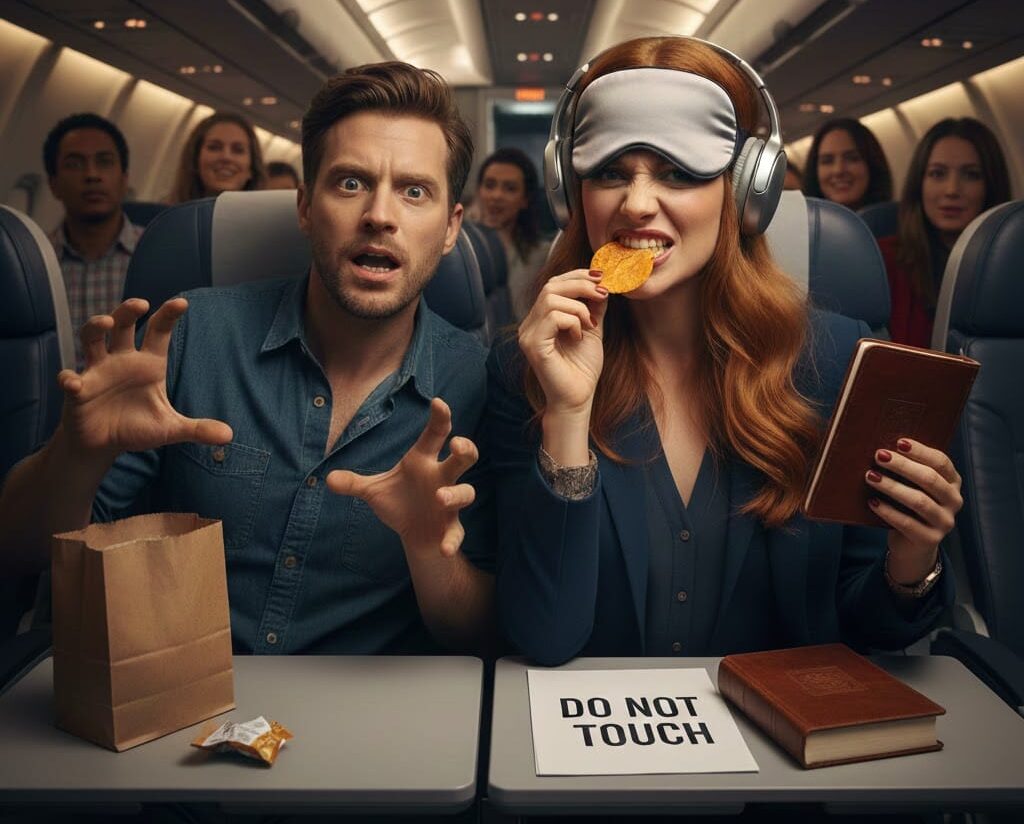
Let’s be honest. You’ve packed your carry-on with surgical precision. Not with chargers or passports, but with snacks. The good stuff. The $8 airport gummy bears that taste like pure joy, the artisanal jerky you hid under your socks, and that perfect, single-serving bag of specialized chips that speaks to your soul.
You settle into your cramped economy seat, the seatbelt sign dings, and you crack open the forbidden treasure. Then, you feel it. The shift. The slow, predatory turn of your partner’s head. Their eyes, previously glazed over by their phone screen, are now locked onto your perfectly seasoned, savory bliss.
The unspoken question hangs in the air, heavier than the recycled cabin air: “Are you going to offer me one?”
The answer is, morally, legally, and spiritually… complicated.
Welcome to the Travel Survival Guide: The Unspoken, Frequently Violated, and Utterly Crucial Rules of In-Flight Snack Sharing. This isn’t just about food; it’s about boundaries, love, and the sacred nature of the travel-sized portion.
🍪 Phase I: The Acquisition (It’s Not Stealing, It’s Strategic Resourcing)
High-quality, monetizable content begins with the premise. Before we even get to the sharing, we must establish the rules of the procurement.
Rule 1: If You Didn’t Pack It, You Don’t Get to Rack It.
This is the cornerstone of Snack Law. If Partner A spent 45 minutes pre-flight scouting for that specific, rare, limited-edition flavor of dried mango and Partner B just sauntered up with a stale mini-bag of pretzels from the airport newsstand, the snack equity is not equal.
Snack Tribunal Ruling: The procurement effort directly correlates to consumption rights. If your contribution to the snack arsenal was merely watching me pay for everything, your rights are severely limited.
Rule 2: The “Pre-Flight Snack Declaration” is Legally Binding.
True couples know that before you board, a verbal inventory must be taken. This is where you declare your intentions.
- “Honey, I got this bag of trail mix for us.” (This is communal property. Sharing mandated.)
- “I got this Kit-Kat for me. Do not look at it. Do not speak of it.” (This is personal property. Sharing highly optional, bordering on grounds for divorce.)
If no declaration is made, the default assumption is solo consumption. Silence, in Snack Law, implies “finders keepers.”
😈 Phase II: The Act of Consumption (The Crunch Heard ‘Round the Cabin)
Now, the rubber meets the runway. You’ve opened the bag, and the crunch echoes in the quiet cabin, a beacon to the hungry soul beside you.
Rule 3: The 30-Second Glance Period
There is a brief, 30-second window after the bag is opened when your partner is allowed a single, non-verbal glance toward your hand. This is the official “I see you have snacks” notification.
If you make eye contact, you may politely offer one. One.
However, if you successfully avoid eye contact, the window closes. Any further attempts to obtain snacks fall under the category of Passive Aggressive Scavenging (P.A.S.).
Rule 4: Addressing Passive Aggressive Scavenging (P.A.S.)
P.A.S. is the highest form of snack abuse and includes:
- The Sigh: A dramatic, loud exhale while looking out the window, clearly signaling existential snack despair.
- The Proximity Lean: Leaning slightly into your personal space, pretending to look at the in-flight magazine, but actually just hovering near the snack’s scent cloud.
- The Question Gambit: “Oh, is that a… is that a peanut butter pretzel? Are they good? I love those. Wow. I haven’t had one of those in ages.” (This is not a question; it is a demand disguised as reminiscence.)
As reported in a study by the Journal of Consumer Psychology, shared consumption in intimate relationships is often less about nutrition and more about emotional compliance and social bonding. However, the study neglected to consider the value of a perfectly toasted sesame cracker, which voids all such compliance.
Rule 5: The “One-Hand” Rule of Offering
If you feel compelled by love, guilt, or the fear of a silent treatment that will last the entire vacation, there is a protocol for offering.
You must only offer the snack using the hand farthest from your partner. This creates a challenging, awkward reach that deters further requests. For example, if your partner is on your right, you offer from your left hand, forcing them to perform a clumsy, public cross-body grab. If they miss, Snack Law states that the offering is rescinded.
🥜 Phase III: Advanced Snack Boundary Management
This section is dedicated to the truly luxurious traveler who understands that personal enjoyment requires strategic defense.
Rule 6: The Decoy Snack
This is an essential defensive strategy for long-haul flights, especially those that cross time zones.
Purchase one snack that is objectively terrible (e.g., a flavorless protein bar or a bag of oddly seasoned kale chips). Present this Decoy Snack with great fanfare to your partner, declaring, “Oh, good! I brought something for us to share!”
While they are slowly choking down the Decoy Snack, you are free to enjoy your premium, vacuum-sealed biscotti in glorious silence. The cost of the decoy is a small fee for the preservation of your own happiness.
A recent analysis by TripAdvisor on couple complaints revealed that “Snack Misunderstandings” ranked higher than “Leaving Dirty Clothes on the Floor” as a source of in-vacation conflict.
Rule 7: The “Nap-Lock” Strategy
If you need a long stretch of uninterrupted snacking, feign sleep.
- Put on your eye mask (the heavier and silkier, the better).
- Lean your head against the window.
- Place your arm (the one holding the good snacks) under your pillow.
- Perform a few dramatic, theatrical sighs.
Your partner will hesitate to wake a sleeping, stressed traveler over a handful of trail mix. This is a temporary, but highly effective, measure.
Rule 8: The “This is for Work” Exemption
This applies if you have a laptop open. Simply state: “I need these snacks for focus. It’s a professional necessity.”
This maneuver works best if the snack is slightly crunchy, which ironically, is the only time crunching is allowed, as it signals “I am important and cannot be disturbed.”
Consider the perspective of The New York Times in their article on travel anxiety, which suggests that having a carefully controlled, comforting ritual (like a specific snack) can be a crucial coping mechanism against the chaos of air travel. It’s not greed; it’s self-care. It’s emotional regulation via cured meats and luxury chocolate.
Rule 9: The Private Chef Precedent
In your own kitchen, you might hire a private chef for a sumptuous party of eight. That is communal luxury. The airplane is the inverse: a confined, high-stress environment where resources (and elbow room) are scarce.
If your partner insists on sharing, simply point to the narrow aisle, the tray table, and the two inches of personal space you have, and ask: “Does this look like a party of eight? No. This is a party of one, and I am the Private Chef.”
🥳 Conclusion: Love Wins (But So Does Your Right to Cheetos)
Ultimately, sharing snacks with your partner is a litmus test for the strength of your relationship. If you willingly offer your absolute favorite, most prized, limited-edition snack—the one you’ve been dreaming about for three states—then that is truly love.
But if you hide the good stuff under your blanket and only offer the sad, generic pretzels you got from the beverage cart, that’s just survival. And honestly? On a long flight, survival is a perfectly acceptable form of marital compromise.
Now, if you’ll excuse me, I hear the flight attendant coming with the drink cart, and I need to strategically re-wrap my peanut butter cups.
📖 Read More
For more tips on achieving peak indulgence and celebrating life’s luxurious moments (with or without your co-traveler), check out these stories:
- Stop Settling: Unlock the Crucial Key to an Absolutely Luxurious Date Night
- The Ultimate Dinner Guide to the Private Chef Costs for Your 8-Person Sumptuous Party
- How to Justify Eating Pie for Breakfast!
- 🐾 ‘Tis the Season to be Jolly, and Also Highly Dog-Friendly: Your Ultimate (and Hilarious) LA Holiday Guide
- 🧐 How to Properly Decimate a Potluck Dish & Still Be Friends!
👩🍳 About the Author
Ginger Graham is the founder and primary author of Culinary Passages. A dedicated epicurean, traveler, and pet parent, Ginger believes that the best things in life—be it a perfect Coq Au Vin, a flawless weekend itinerary, or a luxurious date night—require attention to detail and a healthy dose of humor. She is an expert in maximizing fun while minimizing hassle, and she currently lives in fear that her Goldendoodle, Barnaby, will figure out where she hides the emergency stash of dark chocolate.