In the high-stakes world of nursing, the term “recovery” usually refers to a patient’s post-operative status or the titration of a sedative. But for those of us standing on the other side of the stethoscope, recovery is a personal, often elusive necessity. After fifteen years in the clinical trenches—navigating the erratic beep of telemetry monitors and the soul-sucking fluorescent hum of the night shift—I’ve realized that the “sensory reset” is not a luxury; it is a vital sign.
As we move through 2026, the travel industry has pivoted toward “Longevity Tourism.” No longer content with a simple tan or a souvenir magnet, travelers are demanding cellular-level results. This has sparked a fascinating rivalry on luxury cruise lines: the clinical precision of the onboard IV Medi-Spa versus the elemental, age-old therapy of Sea Air.
As a Registered Nurse and a seasoned traveler with more than 30 cruises under my belt, I decided to put these two modalities to the test. Is the $300 “Immunity Bag” the ultimate hack for the tired professional, or is the ocean itself still the best medicine?
The Rise of the Medi-Spa: Clinical Recovery Precision at 20 Knots
Walking into a modern shipboard spa in 2026 feels less like entering a massage parlor and more like stepping into a high-end surgical suite in Beverly Hills. The aesthetic is “Clinical Minimalism”—brushed gold accents, white marble floors that reflect the ambient glow of recessed LED strips, and the unmistakable sight of IV poles draped in silk covers to hide the metal.
The Recovery Bio-Hack: Why IV Therapy?
Intravenous therapy has moved from the ER to the Lido deck. The appeal is rooted in bioavailability. When we ingest vitamins orally, the digestive tract acts as a harsh filter, often absorbing only 20-30% of the nutrients. According to research published by the National Institutes of Health (NIH), IV administration bypasses the “first-pass effect” of the liver, delivering 100% of the vitamins directly into the bloodstream for immediate cellular uptake.
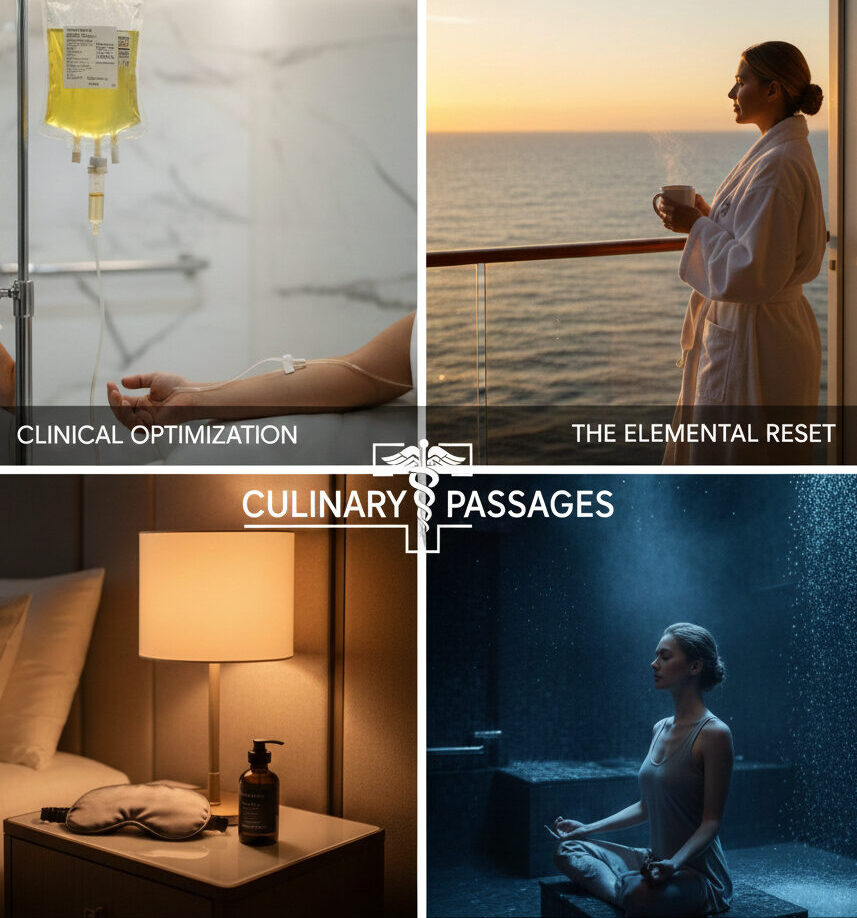
On my recent voyage, I reviewed the “Navigator’s Recovery Drip”—a cocktail of B12, Vitamin C, Magnesium, and Glutathione. For a nurse accustomed to hanging bags for patients in a hectic clinic, sitting in the “patient” chair was a surreal sensory shift.
There is a strange, modern beauty in the clarity of the fluid against the backdrop of the deep blue Atlantic through a floor-to-ceiling window. It’s a “Glowmad” staple—capturing that moment of self-optimization. However, as a clinician, I had to ask: Is this necessary? While Glutathione is a powerful antioxidant for the liver, the “glow” often comes as much from the forced 45 minutes of meditative stillness as it does from the needle.
The Architecture of the Snow Room: 2026’s Coldest Recovery Trend
If the IV is the “work” of wellness, the Thermal Suite is the “play.” Leading cruise lines like Celebrity and Viking have expanded their thermal footprints to include “Snow Rooms” and “Infrared Saunas.”
According to the Global Wellness Institute, contrast therapy (moving between extreme heat and cold) is one of the fastest-growing trends in the $5.6 trillion wellness economy. The visual appeal here is peak “Hushpitality.” Imagine a room tiled in dark obsidian, filled with the scent of eucalyptus, where the only sound is the hiss of steam, followed by a room where real snowflakes drift from the ceiling.
The Nurse’s Critique: From a cardiovascular perspective, contrast therapy is excellent for vasoconstriction and vasodilation, which aids in lymphatic drainage. For “nurse legs” that ache after years of bedside care, the Snow Room serves as a natural anti-inflammatory. Visually, these spaces are designed for the “Quiet Luxury” aesthetic—minimalist, textured, and profoundly calming.
The Dark-Mode Reset: Visualizing the Ultimate Night-Shift Recovery
As a nurse, my relationship with light is complicated. We spend our professional lives under the aggressive, blue-tinted glare of hospital corridors—a lighting profile designed for alertness but disastrous for the circadian rhythm. When I transition from a clinical setting to a luxury cruise, the first thing I evaluate isn’t the thread count of the linens; it’s the luminous environment.
Circadian Lighting: The Invisible Luxury
In 2026, the “Discovery” of wellness has moved into the realm of Circadian Lighting. High-end suites now feature integrated mood lighting that mimics the natural progression of the sun. For the night-shift nurse, this is a game-changer. The visual transition from the harsh “Cool White” (5000K) of the nursing station to the “Warm Amber” (2700K) of a luxury suite signals the brain to begin melatonin production.
When reviewing these spaces, I look for “Blackout Integrity.” To capture the perfect visual for your blog, focus on these “Dark-Mode” elements: the amber glow of a high-end bedside lamp, motorized blackout curtains, and a nightstand flat-lay of recovery essentials like a silk eye mask and Lesse serum. By documenting these moments, you provide a blueprint for how a professional can reclaim their sleep through intentional, aesthetic choices.
The Elemental Reset: Why “Sea Air” is the Original Bio-Hack
While the Medi-Spa focuses on the internal, the “Sea Air” movement focuses on the environmental. In 2026, we are seeing a return to Biophilic Design—ship architecture that maximizes exposure to the elements through cantilevered decks and open-air “Magic Carpets.”
The Science of the Horizon
There is a physiological reason why looking at the ocean feels like a “reset.” This is known as “Blue Mind” theory. Research led by marine biologists and featured in National Geographic suggests that proximity to water lowers cortisol levels and increases serotonin.
As a nurse, I monitor the body’s “fight or flight” response daily. The ocean acts as a natural vagus nerve stimulator. The negative ions found in sea spray are believed to increase our capacity to absorb oxygen and balance serotonin levels. When you stand on a private balcony at 6:00 AM, the sensory input—the rhythmic salt-spray, the cool humidity, the absence of “hospital white” lighting—performs a neurological recalibration that no IV bag can replicate.
The Financial Diagnosis: Is it Worth the Spend?
Luxury travel in 2026 is an “experience economy.” We are often forced to choose between the “AquaClass” upgrade (which includes thermal access) or paying a-la-carte for medi-spa treatments. If you are using tools like the inKind app to manage your dining budget on land, you know that value is about more than just the price tag—it’s about the ROI on your well-being.
- The IV Drip: Best for those arriving dehydrated from long-haul flights or those who have overindulged in the ship’s fine dining and wine pairings. It is a “quick fix” for physical symptoms.
- The Sea Air/Thermal Access: Best for the “Sensory Reset.” This is a slow-burn recovery that improves sleep quality and mental clarity over the duration of the cruise.
Conclusion: The Final Prescription
After reviewing both, my professional recommendation is a hybrid approach. The IV Medi-Spa is a fascinating tool of modern science, a testament to how far we’ve come in the quest for longevity. But it lacks the soul of the sea. For the nurse, the parent, or the overworked professional, the true “Discovery” isn’t found in a needle—it’s found in the transition from the sterile world of “doing” to the salt-crusted world of “being.”
The next time you find yourself on the 35th floor of a hotel or the aft deck of a ship, take a breath. The air is free, the horizon is infinite, and your nervous system knows exactly what to do with it.
Read More: Continue Your Sensory Reset
- The 2026 Los Angeles inKind Guide: How to Eat at LA’s Best for 30% Less
- 7 Expensive Luxury Cruise Packing Mistakes
- Recharge Your Life Near LA: 5 Powerful “Silent Travel” Getaways
- 5 Moody PNW Lodges: Finding Your Wilderkind Sensory Reset
- A Nurse’s Guide to Luxury Cruise Wellness: Arrive Home Healthy, Not Burnt Out
About the Author
Ginger Graham is a Registered Nurse with nearly 15 years of experience in bedside, procedural, and clinic nursing. When she isn’t navigating the complexities of healthcare, she is the creative force behind Culinary Passages. A veteran traveler with more than 30 cruises under her belt, Ginger specializes in decoding the world of fine dining and luxury travel through a clinical lens, helping her readers find the ultimate “sensory reset.” She lives in Los Angeles with her husband, Brad, their two daughters, and their goldendoodle, Barnaby.