ORLA, Michael Mina’s restaurant at the Regent Santa Monica Beach, isn’t the restaurant it used to be. We’ve been three times before, and every time we left already planning the next visit — this time, for the first time, we won’t be. Here’s what happened, and what it says about a restaurant coasting on its old reputation.
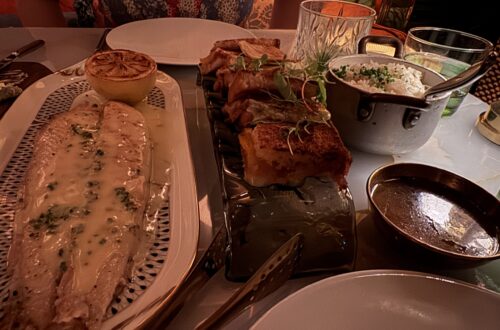
Last week, my husband Brad, our eight-year-old daughter, and I headed to ORLA at the Regent Santa Monica. Now, to set the stage: ORLA wasn’t just a restaurant to me; it was a personality trait. I’d written glowing reviews about this place, defended its price point, and heralded Michael Mina as the king of the coastal kitchen. In fact, I’d even dreamed about the phyllo-crusted sole in a way that is probably legally questionable in some states.
But the catalyst for this specific visit? It wasn’t my craving for high-end Mediterranean flair or a desperate need for a white tablecloth. It was my daughter. She looked at me with those big, innocent eyes and said she “liked their lemonade.”
Folks, we went to a Michael Mina restaurant—a place where the dinner bill usually looks like a monthly car payment—for the lemonade. That should have been my first warning sign, because if an eight-year-old is the primary stakeholder in your fine-dining decisions, you are already playing a dangerous game of culinary roulette.
ORLA Great Gilded Entrance to Disappointment
The evening started with a lie. The Regent Santa Monica is, quite frankly, gorgeous. The staff is polite, the lobby smells like money and success, and the ambiance at ORLA still whispers, “You are successful and deserve a $24 cocktail.” We walked in, feeling like the main characters in a luxury travel brochure. The host was charming, the lighting was dim enough to hide my “mom-tired” eyes, and everything seemed on track.
Then, we opened the menu.
Change is usually good. In a marriage? Great. In your skincare routine? Necessary. In the menu of a restaurant that already had a perfect, balanced lineup? Terrifying. We noticed immediately that the offerings had been trimmed down. It felt less like a curated selection and more like a “we’re trying to survive the inflation apocalypse” selection. The soulful, creative items that made ORLA unique seemed to have been replaced by “safer,” cheaper-to-produce alternatives.
Since we weren’t starving, we decided to skip the heavy hitters and pivot to a “Mezze Extravaganza.” We figured, “Hey, it’s Michael Mina. Even the small plates are going to be life-changing.” In retrospect, I should have just ordered a glass of water and left while my dignity was intact.
1. The Not – So – Great “Fishy” Hamachi Crudo
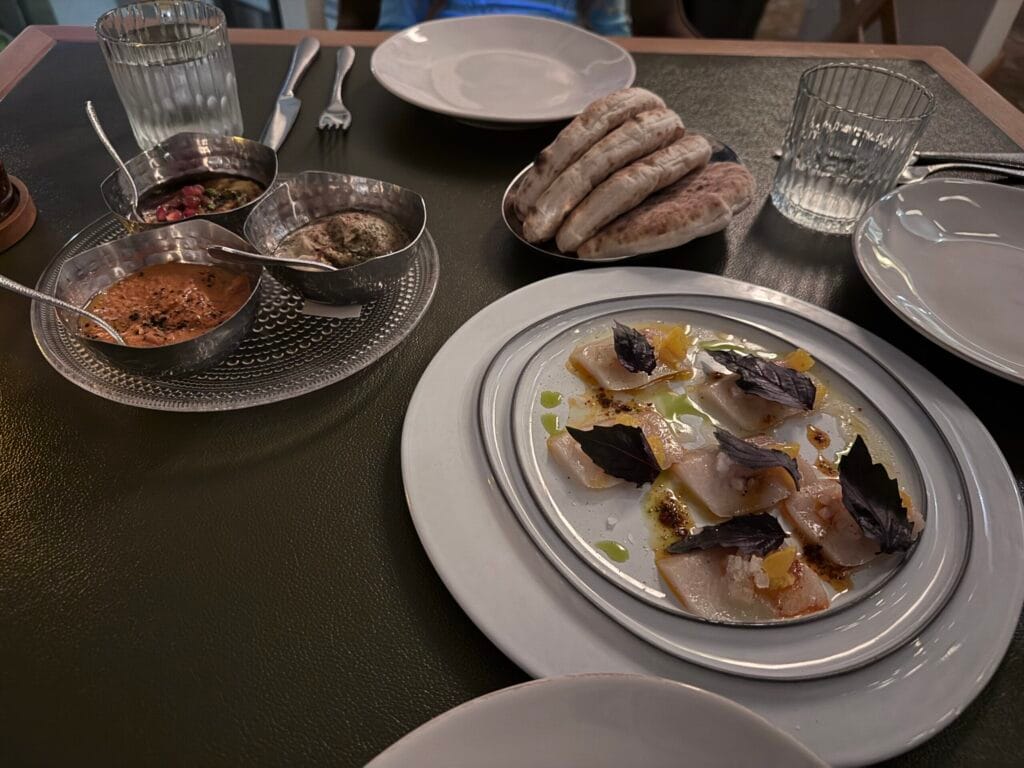
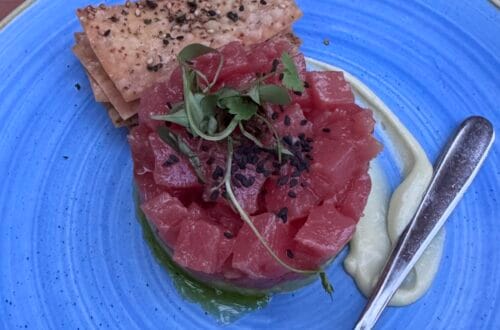
We started with the Hamachi Crudo. We’ve had this before; it used to be a masterclass in acidity, brightness, and buttery texture. This time? It was a masterclass in “Why does this taste like a pier in July?”
Brad took one bite, made a face usually reserved for discovering a dirty diaper in a luggage compartment, and pushed the plate away. “It’s fishy,” he whispered. When your husband—a man who has navigated the complexities of high-end dining across the globe—won’t touch a raw fish dish at ORLA, you have a problem. “Fishy” is a four-letter word in an Omakase-adjacent environment. It shouldn’t be a flavor profile; it’s a warning label. It lacked that translucent, fresh-from-the-ocean snap that justified the price tag. Instead, it felt tired. Over-handled. It was the culinary equivalent of a movie sequel that nobody asked for.
2. The Dips that Came from the Deli
Next came the Trio of Dips. This was circled on the menu as a “Featured Dish.” Featured by whom, exactly? Perhaps the local grocery store’s clearance aisle.
I am a regular at the Santa Monica Farmers Market, spending my Wednesday mornings dodging strollers to get the freshest produce in the zip code, so I know what good hummus and babaganoush taste like—and this was not it. This didn’t taste like ORLA at its best, or like Michael Mina’s kitchen; it tasted like a Tuesday afternoon at a generic catering hall. There was no depth, no “wow” factor of high-quality olive oil, and no smokiness in the eggplant. The “mezze” should be the heartbeat of the meal. This heartbeat was flatlining.
ORLA and the Great Truffle Tragedy: Bleach or Botanicals?
Then came the Macaroni Béchamel.
Now, I love a great truffle, because I’m the person who thinks “too much truffle” is a myth, like unicorns or a stress-free trip to the DMV. However, when the plate hit the table, the aroma arrived three seconds before the dish did. Brad sniffed the air, his brow furrowing.
“I smell bleach,” he said.
I laughed. “Brad, don’t be dramatic. It’s probably just the high-grade cleaning supplies they use for the marble floors in the lobby.”
I took a bite. Then another. Then I realized my husband wasn’t being a “food snob”—he was being an investigative reporter. The stench—that sharp, chemical, “I’m about to scrub the bathroom tiles” aroma—was the black truffle.
For those who aren’t obsessed with fungi, here is a fun fact: when black truffles are overripe, spoiled, or—heaven forbid—low-quality synthetic oils are used, they don’t smell like earthy heaven. Instead, they smell like a swimming pool, which was heartbreaking. A dish with that profile in a restaurant of this caliber is the culinary equivalent of wearing sweatpants to a black-tie wedding — it just doesn’t happen here. For example, a chemical or “cleaner” smell is a major red flag for the quality of the fungus, so we stopped eating it immediately. The fear of “truffle-induced chemical poisoning” is a real mood-killer for date night.
The Kid’s Verdict
At this point, even the eight-year-old was checking out. She pushed her pasta marinara away. This is a child who considers pasta a primary food group and would eat it for breakfast if I let her, so that says something. “It’s too salty, Mommy,” she pouted. I tasted it, and she wasn’t wrong. It was like the chef had accidentally dropped the entire salt cellar into the sauce and decided, “Eh, the kid won’t notice.” She then reached for her legendary lemonade—the entire reason we were in the building. However, she took a sip, winced, and set it down. “Too sour.”
When you can’t get the lemonade right for an eight-year-old, you’ve lost the room.
ORLA and the Saganaki Slog: The 24k “Participation Trophy”
We also had the saganaki. Typically, this is a showstopper—salty, melted cheese with a hit of honey and lemon. This was… fine. However, “no big deal” shouldn’t be the takeaway from a $30 cheese plate, and we didn’t even finish it. When you leave half a plate of melted cheese on the table, you know the meal is a disaster. It felt rubbery, lacking that signature crust that makes saganaki a literal fire-fueled joy. For a place with ORLA’s price tag, “fine” is not good enough.
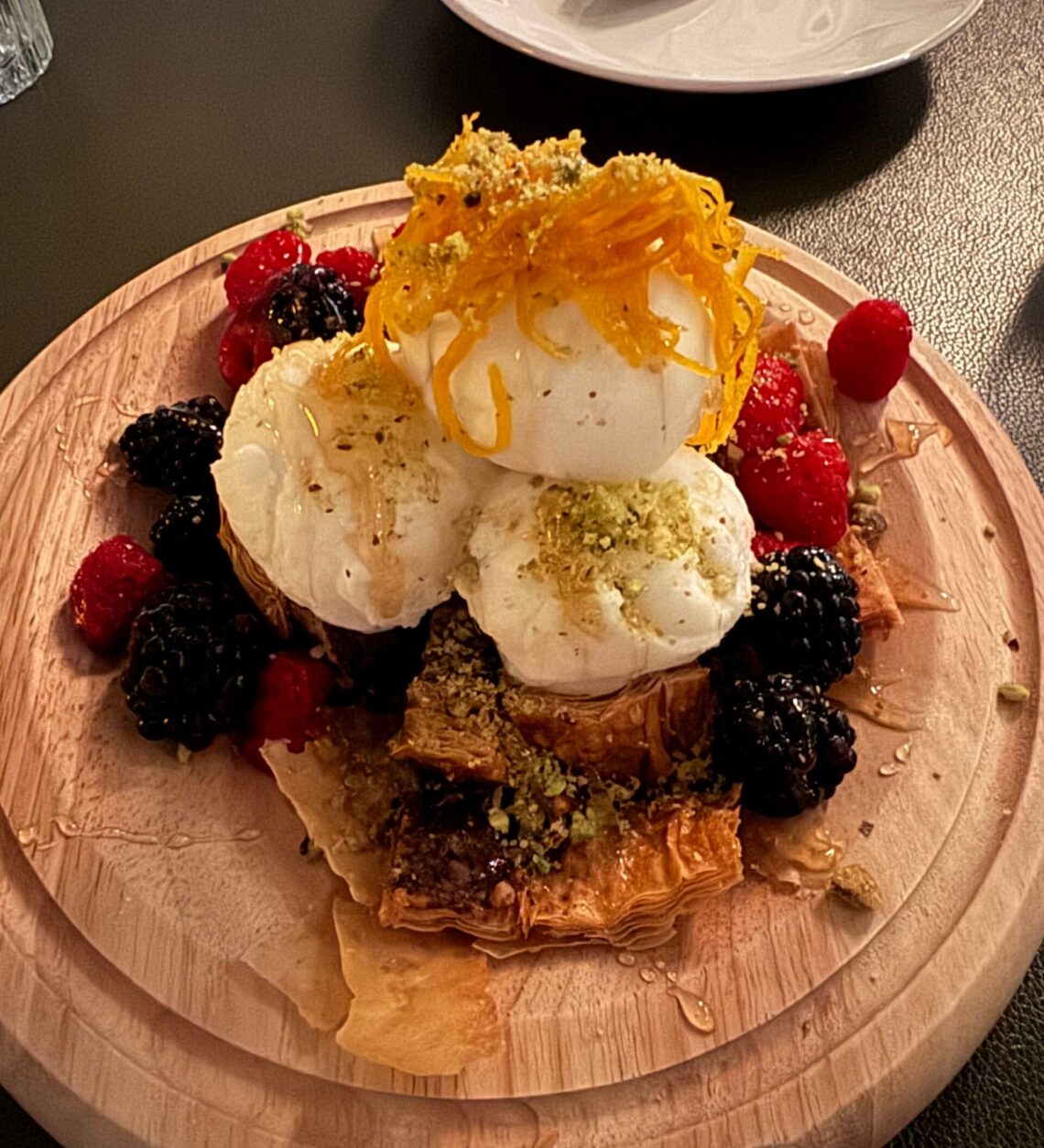
We finished (well, “finished” is a strong word; we “endured”) with the 24k Golden Baklava Sundae. It’s served tableside with all the theatricality of a Broadway show.
In the past, this was the highlight of our month. This time, however, it was… just okay. It was the only thing we didn’t actively dislike, but it felt tired, like a rockstar who has played their hit song 10,000 times and is just waiting for the tour bus to arrive so they can go to sleep. Although it was better than the bleach macaroni, that is a bar so low it’s currently in the basement of the Regent. The baklava wasn’t as crisp as it used to be, and the “gold” felt more like a distraction from the lack of flavor than a luxury addition.
The Economics of “Cutting Corners” at ORLA
I understand that the hospitality industry is in a weird place, because I know that food costs are up, labor is a challenge, and everyone is trying to stay afloat. However, there is a way to cut corners, and then there is whatever happened at ORLA.
When you go to a restaurant with a name like Michael Mina attached to it, you aren’t just paying for the calories. You are paying for the brand, the expertise, and the assurance that the ingredients are top-tier. When you charge luxury prices but serve “farmers market at best” quality, you break the silent contract between the chef and the patron.
The creativity was gone — the uniqueness that once made ORLA the “Final Boss” of Santa Monica dining had been replaced by a mediocre, overpriced ghost of its former self.
Why We Didn’t Complain
People always ask me, “Ginger, why didn’t you send it back? Why didn’t you call for the manager?”
The answer is simple: it wasn’t a “one-off” mistake. If a steak is overcooked, you send it back. If a waiter forgets your drink, you speak up. But when the entire quality of the ingredients—from the fish to the truffles to the salt levels in a kid’s meal—has plummeted, what is there to say?
“Excuse me, could you please make the entire kitchen better and go back to 2025?”
Consistency is the hallmark of a great establishment, and ORLA has lost its consistency. As a result, it has traded its soul for a simplified menu and lower-tier sourcing.
We paid the very expensive bill, tipped the very nice staff (who truly were wonderful—this isn’t on the servers!), and walked out into the cool Santa Monica air. We felt lighter in the wallet, heavy in the heart, and slightly concerned about the bleach-smelling macaroni lingering in our systems.
Sadly, we will not be going back to ORLA, because there is no reason to. In a city where you can get a world-class meal on every other corner, there is no room for “expensive and mediocre.” So this is goodbye — not to ORLA the restaurant, but to the ORLA we used to love. You were great while it lasted, and I hope you find your way back.