There are moments in a marriage that test your alignment, your shared vision for the future. Debating what to name your first child is one. Deciding whether to move across the country is another. But I’m convinced the ultimate stress test is standing in your living room, looking at your beautiful, hopeful children, and trying to find a gentle way to respond to the thermonuclear question: “Can we get a doodle puppy?”
Here at Culinary Passages, our usual negotiations revolve around food. We broker peace treaties over the last slice of pizza, conduct high-stakes diplomacy on the subject of broccoli, and celebrate the rare culinary victory of a clean-plate-club dinner. I thought I was a seasoned veteran of the family bargaining table, capable of navigating any request with grace and a well-reasoned counteroffer.
I had never faced the Puppy PowerPoint.
My daughters, ages ten and seven, launched a campaign of attrition that would make a military strategist weep with pride. They left hand-drawn pictures of puppies on my pillow. They “casually” played YouTube videos of laughing babies snuggling with Golden Retrievers. The coup de grâce was a multi-slide presentation detailing their solemn vow to handle all walking, feeding, and poop-scooping duties for the next 18 years. It was a masterpiece of propaganda.
My husband and I held a late-night summit. We were outnumbered and outmaneuvered. We knew we couldn’t win. We could only hope to compromise. “Okay, okay,” I conceded, “But if we do this, it has to be the right kind of dog. Something smart, family-friendly, and… please, for the love of my vacuum cleaner, something that doesn’t shed too much.”
And so, the algorithm of modern suburban desire led us to the one, the only, the Goldendoodle. The walking teddy bear, the hypoallergenic unicorn, the undisputed mascot of families everywhere. This is the story of how our lives were joyfully, chaotically, and irrevocably hijacked by a fluffy whirlwind of paws and licks named Barnaby. If you’re considering welcoming a Doodle into your home, cancel your brunch plans and settle in. This is the real, unfiltered, and slightly fur-covered guide to life in the Doodleverse.
Chapter 1: The Doodle Acquisition Phase – Operation Fluffernutter
Finding a gerbil, I learned, is a simple transaction. You go to a store, you point at a furry potato, and you bring it home. Finding a Goldendoodle, however, is like trying to get a reservation at the hottest new restaurant in Los Angeles. There are waiting lists. There are applications that ask deeply personal questions about your yard’s square footage and your philosophy on squeaky toys. There are interviews with breeders who rightly want to ensure their precious fluffballs are going to a good home. It felt less like getting a pet and more like pledging a very exclusive, very fluffy fraternity.
When the fateful day came, we embarked on what felt like a sacred pilgrimage. The destination was not a bustling pet store, but a quiet home two hours away. This was a far cry from my usual weekend jaunts to a local farmers market, where the biggest decision is which variety of heirloom tomato to buy. Those blissful, sensory-rich outings are my happy place, something I tried to capture in my guide: “Farmers Markets Southern California Guide: Exclusive Hidden Treasures.”
This journey was different. The air in the car wasn’t filled with the scent of fresh basil, but with the electric hum of my children’s barely contained excitement.
And then we saw him. A tiny, apricot-colored puffball with giant paws and dark, soulful eyes. He tumbled over his own feet, let out a tiny “boof,” and promptly tried to chew on my shoelace. It was over. We were smitten. The carefully constructed walls of parental reason crumbled into dust.
The ride home was a blur of puppy breath and my daughters’ happy squeals. We named him Barnaby. He slept in a laundry basket on my eldest’s lap, a tiny, snoring engine of impending chaos. We walked into our clean, quiet, orderly house, and as his paws pitter-pattered across the hardwood for the first time, I knew with absolute certainty: our old life was over. The Age of Doodle had begun.
Chapter 2: The Culinary Experience – A Foodie’s Guide to Doodle Kibble Connoisseurship
As someone who writes about food for a living, I naively thought I’d be immune to the marketing gimmicks of the pet food industry. I was wrong. The dog food aisle is a dizzying landscape of buzzwords that rivals the Erewhon supplement section. Grain-free! Single-source protein! Human-grade! Freeze-dried raw toppers!
I found myself in a rabbit hole of research, scrutinizing ingredient lists with the intensity of a food critic. “Does this kibble have too many legumes? Is this salmon ethically sourced, or is it farmed? Should we be considering a raw diet? What are his macros?!”
The truth is, providing a healthy diet is the most important thing you can do for your pet. The American Society for the Prevention of Cruelty to Animals (ASPCA) provides clear guidelines on canine nutrition, emphasizing the need for a complete and balanced diet appropriate for a dog’s life stage. They offer a wealth of information that cuts through the marketing noise and focuses on what dogs actually need to thrive.
Of course, this sensible advice didn’t stop me from buying a bag of premium, salmon-and-sweet-potato formula kibble that cost more per pound than the organic chicken I buy for my family. I purchased single-ingredient “treats”—dehydrated Icelandic cod skins that made my pantry smell like a medieval fishing village—and artisanal peanut butter-and-bacon dog biscuits from a boutique pet bakery.
And what does Barnaby, our little gourmet, love more than anything in this world? The answer is twofold: a dirty sock he has stolen from the hamper, and the crusts from our seven-year-old’s pizza. He will turn his nose up at a dollop of organic pumpkin puree but will risk it all for a crumb of fallen cheese. It’s a humbling culinary lesson. You can source the finest ingredients in the world, but sometimes, the heart simply wants what it wants—even if it’s floor-cheese.
Chapter 3: The Habitat – My Home is Now a Chew Toy
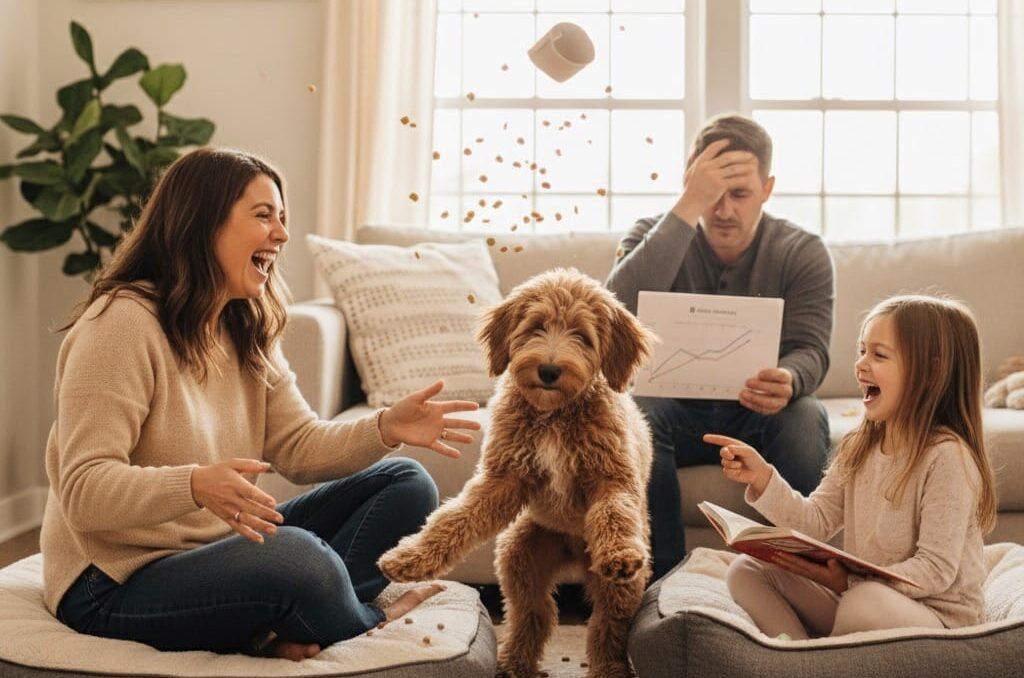
A gerbil’s habitat is a cage. A Goldendoodle’s habitat is your entire life. Our once-stylish living room has slowly transformed into a puppy-proofed obstacle course. The beautiful woven basket that held magazines now holds a jumble of squeaky hedgehogs and unnervingly durable rubber bones. The sleek coffee table has been replaced by a giant, orthopedic dog bed that is objectively more comfortable than my first apartment’s mattress.
Animal welfare organizations like The Humane Society of the United States talk about the importance of enrichment for dogs—providing toys, puzzle feeders, and training to keep their minds stimulated. This is excellent advice. What they don’t fully prepare you for is the sheer destructive capability of a bored Doodle puppy. Enrichment isn’t just a fun activity; it’s a necessary defense strategy to protect your baseboards, your shoes, and the structural integrity of your sofa cushions.
And then there’s the cleaning. Oh, the cleaning. I thought I knew messes. I have two children. I’ve survived spaghetti nights and glitter-based art projects. But nothing prepares you for the moment your adorable, fluffy puppy has an accident on your favorite area rug. It’s a special kind of soul-crushing defeat. It’s a mess that lingers, both physically and emotionally, not unlike our family’s disastrous dinner at Zaytinya, an experience so disappointing it warranted its own post-mortem: “An Honest and Unsponsored Review of Zaytinya in Culver City.” In both cases, a significant amount quiet reflection was required.
Chapter 4: Health, Wellness, and the Awkward Sociology of the Dog Park
The first year of puppy ownership is a blur of vet visits. There are vaccines, check-ups, and panicked, late-night calls to the emergency vet because the puppy ate something mysterious in the backyard. My Google search history is now a terrifying chronicle of canine anxieties: “Can a puppy survive eating a cicada?” “How much mulch is too much mulch?” “Reverse sneezing vs. choking HELP.”
For anyone navigating this panic, I recommend bookmarking a reliable source like PetMD, where veterinary professionals offer clear, factual articles that can help you determine if you’re dealing with a true emergency or just a classic case of puppy weirdness.
And then there’s the grooming. A Goldendoodle is not a dog; it is a high-maintenance hairdo with legs. Their beautiful, fluffy coats require constant brushing to prevent matting. Their professional grooming appointments cost more than my own haircut and color, and they happen twice as often.
But perhaps the biggest lifestyle change is the forced socialization—for me, not the dog. Welcome to the dog park. It is a strange and fascinating social ecosystem where adults stand in a field, holding leashes and coffee cups, making small talk while their dogs engage in complex, butt-sniffing rituals. It’s a place where you learn to navigate the intricate politics of “he’s friendly!” declarations and passive-aggressive comments about off-leash etiquette. It can make you desperately wish for a quiet, judgment-free ride home, a topic we’ve pondered before in “LA Family Rideshare Face-Off: Waymo vs. Uber.” Good luck explaining the smell of wet dog and communal drool to your Uber driver.
Chapter 5: The Slobbery, Heart-Exploding Payoff
So, after all the chewed-up shoes, the muddy paw prints on clean floors, and the eye-watering vet bills, you might be asking: is it worth it?
The answer is a resounding, unequivocal yes. A thousand times, yes.
Because for every moment of frustration, there are a hundred moments of pure, unadulterated joy. It’s the full-body wiggle and ecstatic greeting you get every single time you walk through the front door, whether you’ve been gone for ten days or ten minutes. It’s the way Barnaby rests his big, fluffy head on your lap when you’re feeling down, as if he just knows. It’s watching my daughters take on the real responsibility of caring for him—measuring his food, brushing his coat, and patiently teaching him to sit.
The science backs this up. The Human Animal Bond Research Institute (HABRI) has shown that the bond between humans and their pets has tangible benefits, from reducing stress to combating loneliness. For kids, it’s even more profound, teaching empathy, nurturing, and responsibility.
Barnaby has forced us to get outside more, exploring local trails and parks. He has become the furry, four-legged glue that connects us, the subject of all our best family stories. He is a constant, living reminder that the best things in life are about love, loyalty, and the simple joy of a good belly rub. Like our family’s unexpectedly perfect dinner at Chelsea Restaurant, which you can read about here, “Chelsea in Santa Monica: Our Go-To Family Dinner Spot,” Barnaby has brought a surprising and immeasurable amount of happiness into our lives.
So, if you’re standing on the precipice of Doodle ownership, take the leap. Your house will be messier. Your clothes will be perpetually covered in a light dusting of fur. You will spend an alarming amount of time discussing the consistency of your dog’s poop. But your life will be infinitely richer, funnier, and filled with more unconditional love than you ever thought possible. And that’s a culinary passage worth taking.